Access Control
In these security conscious days Acccess Control has become big business. No apartment block or commercial building, however modest, is without some kind of entryphone or access control system. In some cases this will be linked to the central BMS system which is monitoring all other functions of the building, in other cases it will be a simple stand-alone system with hands-free communication between tenant and visitor and, more frequently now, with a miniature video camera built into the unit. The access control unit will also have a means of identifying tenants or regular users of the entrance - this would be either a magnetic swipe card or proximity card.
Question?
An apartment building comprises three 7-story towers together with 14 entrances some of which serve only one block and others give access to all blocks via a leisure deck. How does one wire up the entry system so that any visitor arriving at any entrance can speak to the apartment they are visiting without having to build a telephone exchange inside the building.
Answer
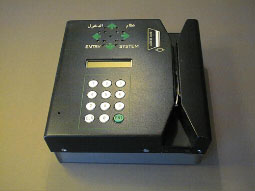
You don't build a telephone exchange as one already exists which serves all apartments, assuming the tenants are on the phone. We don't claim to have originated this idea, by the way. Fortunately this project was in the Middle East where the phone company provided free local calls but this is becoming a trend in many parts of the world. The Sentinel operated as a hands-free telephone on a standard telephone jack with its own phone number.
How does it work?
Let us assume the visitor to an apartment knows only the apartment number so that is what they enter on the keypad at the road-level entrance. The Sentinel is attached to the cetral computer in the BMS system (which in this case we also provided) and a database of apartment phone numbers is held in memory. On receiving an entry, the BMS system transmits the apartment phone number back to the Sentinel and instructs it to dial the apartment. This takes less than a second. The visitor and the tenant speak long enough for the tenant to identify that the visitor is not selling double glazing and the tenant keys in '22' on their phone keypad and the Sentinel picks this up and releases the door. Why two key presses? The reason is ingenious! If a fraudulent visitor attempts to mimic the sound of the tones on the Sentinel microphone then they will be defeated - the microphone is muted on the first tone so that only a genuine double key press in the apartment will open the door. Obviously there are other codes such as 11 which ends the conversation and keeps the door shut.
The Sentinel also has a couple of fixed phone numbers so that a visitor can speak directly to the security officer in the control room or to the Centre receptionist just by keying in 100 or 800.
The Sentinel also included standard items such as special pass numbers and swipe card reader. One would think that, in the dusty and sandy atmosphere of a Middle East city, swipe cards and the readers would not last long but we were pleasantly surprised during the 10 years the system was in operation.
The main snag with the telephone half of the Sentinel is that it would not be popular if tenants had to pay for a local phone call each time someone visited the apartment. A modern solution is to take advantage of CAT5 networking systems and we've discussed in 'About Us' how the house (and building) of the future will comprise its own 'bus' down which a whole variety of signals travel.
The CMC50 Card Reader
Among our products is a simple microprocessor-controlled card reader, the CMC50, which reads standard magnetic cards and either looks up the card in its own internal memory to decide whether to operate an internal relay or transmits the card number on a serial cable to a PC Com Port. There is no realistic limit to the number of cards stored in the unit, memory chips are so vast these days. The CMC55 is ideal as an input device for a larger PC-based system, for example a checking-in system for visitors to a sports or health club. The photo shows the CMC50 reader - the finish is stainless steel and it is left blank so that it can be engraved with the user's logo.

Important things to remember about Access Control
A simple access control system could comprise a PC with a card-reader and door release but what happens if the PC is busy or has broken down? The answer is that the access control system would no longer be operational or would, at the very least, be subject to delays.
It is essential that the access control is a completely independent 'sub-system'. In our case it comprises a small control cabinet with a CM55 microprocessor-based memory system and various connections to the building - the door lock, card reader, manual door release from inside, etc. For sites where there is no actual door control, the whole system resides inside the card reader and the reader connects directly to the PC. This sub-system communicates with the main PC in order to receive data on valid cards but this only occurs when card data is changed, for example, when a new member joins. The PC also 'polls' the sub-system at regular intervals in order to record a history of events but this can be anything between once per second to once per day as the sub-system contains a 'memory stack' of events which is retained until the next poll so nothing is lost. Using such a sub-system ensures that the door is released immediately on receiving a valid card swipe.